27.09.2026 World-Tour, News, Race news
KASIA SECOND IN EXTRAORDINARY WORLD CHAMPS SHOWDOWN
It has already been spoken of as the greatest women’s race in recent memory, perhaps even of all time, after a succession of mesmerising moments produced an extraordinary 180-kilometre spectacle in Canada.
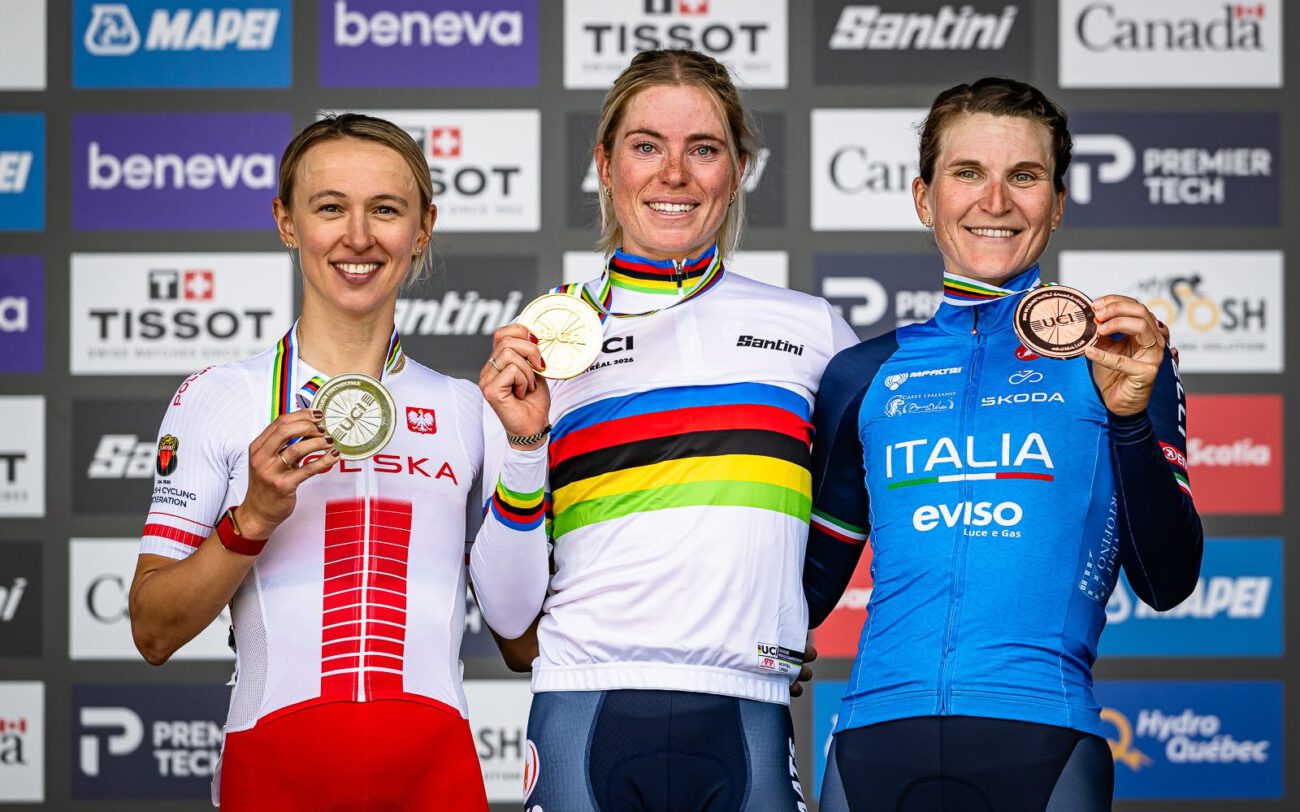
Central to the drama was Kasia Niewiadoma-Phinney, who crossed the line second after a gruelling yet remarkable Elite Women’s Road Race at the 2026 UCI Road World Championships, completely spent after producing a phenomenal performance alongside eventual winner Vollering (NED), bronze medallist Longo Borghini (ITA) and a cast of major protagonists including Reusser (SUI).
Cruelly, the rainbow jersey was within Kasia’s grasp until the last 50m, when fatigue finally became too much. Her body simply had nothing more to give as Vollering came over the top to claim the sport’s ultimate prize.
Yet, there was no sense of disappointment in Kasia’s demeanour. The Polish rider beamed with pure delight as she embraced her emotional national teammates, before exchanging immediate post-race thoughts with rivals turned confidantes.
Having claimed one previous World Championships road race medal (Leuven, 2021), another was a huge reward.
“Honestly, I’m just happy with my own performance because I absolutely gave 150% of what I had today, and I knew that I was well prepared. I fought for it with the team and we rode a really nice race together,” Kasia said once the emotions had begun to settle.
“Of course, we are here to fight for the rainbow jersey, but I also know that I was up against probably the best rider in the world, so I feel satisfied knowing that I gave it my best. It doesn’t mean that I am necessarily satisfied with second; I still want to win, and work even harder towards that, but it’s great to see and feel that each year, I can still make progress. Victory certainly would have been a very different feeling, but it just gives me extra motivation for the future.”
Serving both as a metropolitan park and a defining geographical landmark, the host city’s namesake – Mont Royal and its urban surrounds – provided a rugged battleground for all of this year’s road races.
Before tackling the savage roads of the 13.4km Mont Royal circuit, which snaked across a four-climb, saw-tooth profile and packed in 269m of elevation, the peloton first pre-loaded the legs with a largely flat 62km loop south of Montréal. The journey across the St Lawrence River to Montréal Island marked the point at which the racing truly came alive – “alive” barely doing it justice.
The technicality and terrain had the peloton under pressure with well over 100km still to race. An early three-rider break was soon swept up, while a large crash created both disruption, splits and heartbreak. With two of eight circuits complete and 80km still to race, the front group had already been whittled down to ~40 riders, including Kasia, Antonia Niedermaier and Zoe Bäckstedt.
A critical juncture was reached when Vollering attacked with 39km and three laps remaining on the upper slopes of the biggest climb, Camillien-Houde (2.3km at 6.2%), her move expertly set up by a cohesive Dutch squad.
Kasia worked hard in the seven-rider chase, under pressure but never out of contention. She mirrored Vollering’s move from lap six, launching her own attack in pursuit of the Dutchwoman one lap later and drawing out Italy’s Longo Borghini.
The pair were caught by others, but Kasia went again soon afterwards on the crowd-favoured Polytechnique climb (800m at 6%). Once again, Longo Borghini followed, also joined by Labous (FRA), who began to lose contact as Kasia pressed on up the prickly Avenue Pagnuelo (500m at 7.5%). Simultaneously, the duo reeled Vollering back in and reset the game board.
Already, there were remarkable displays of resilience, composure and strength all round.
“When she [Vollering] first went, my legs just exploded”, Kasia described. “They were full and felt like balloons, but once I overcame it, I was back in the game. So, I’m happy that I did not give up or think that I was rubbish today; I kept on believing in myself, and that the rainbows were there to be won.”
That belief, mixed with quiet confidence, never wavered, keeping Kasia in the fight and ultimately bringing her back into the hunt for the rainbow jersey.
“Honestly, you can never lose your belief until you finish the race. So, the whole time when she [Vollering] was in front of us, I kind of knew that we might be able to catch her because at least we were able to see her.”
Kasia went on:
“It [the thought of rainbows] never left my mind. I tried my best to stay patient and observe everything – use others and use my matches only when it really mattered.”
Despite Longo Borghini attacking through the finish ahead of the final lap, the race was still in constant flux, flipping and flipping again. This time, Kasia and Vollering crested the final ascent of Camillien-Houde together with little more than 10km to go, before trading blows on Avenue Pagnuelo with 4km remaining. The effort was etched across both their faces as they crested that penultimate rise, each taking the briefest of pauses before pressing on.
Behind, Longo Borghini and Reusser were refusing to let the race slip away. Each was locked into a separate, increasingly desperate pursuit of the two riders ahead, but neither could quite close the final gap. They would ultimately cross the line four and eight seconds behind respectively.
Just in front, two exhausted athletes were left to fight it out for gold. Cruelly, the final 400m rose at an average gradient of 5% to the line, demanding every ounce of energy as payment for a revered rainbow jersey.
Kasia knew that restraint and a sharp kick would be crucial but, after almost five hours of racing, there was only so much left in the tank.
“I just knew that I had to wait, wait, wait because the sprint would be very long. I tried to be patient before I started at 150m to go but even then, my legs exploded into cramps in the last 50m, so I was just like ‘I hope I can just cross the finish line and that’s it’. The race was so hard and actually was warmer than anyone expected, so my body was simply at its limit.”
Finding a tougher, more captivating race in Kasia’s memory would take some searching.
“I’m just so happy that we can show women’s strength in such an entertaining way. It was definitely one of the hardest races I’ve ever done in my life. It was constantly up and down, left and right, so you were always fully on – both mentally and physically. I think we were all happy when it was finished; there were so many attacks and so many different situations happening. At the end of the day, Demi [Vollering] won, and we can all say that she is a deserved winner.”
Asked if there was anything she could have done differently, Kasia pointed not to an in-race decision or tactical miscalculation, but to the preceding weeks.
“Maybe I would have actually done a race before this one, because I felt like I had a long break after the Tour de France Femmes avec Zwift, and sometimes you just need a proper opener for your legs to feel different and alive. I definitely I had that when Demi attacked the first time, so then luckily, my legs came around and felt amazing. But, I would rather not have that in the race – not in an important race, anyway!”
Indeed, this was an important race in every sense. It carried all the prestige and history of a World Championships, while also serving up a spectacular showcase of the depth, strength and sheer unpredictability of modern women’s cycling.
Antonia and Zoe were CANYON//SRAM’s two other finishers, making strong contributions for their respective German and Great Britain teams before the race entered its decisive final 40km, eventually rolling across the line in 28th and 34th.